Something changed when AI started answering questions directly. Google now generates AI Overviews for a significant portion of informational queries. ChatGPT handles over a billion queries a week. Perplexity grew faster than almost any consumer product in recent history.
The SEO playbook — built around 10 blue links and ranking position — wasn’t designed for any of this. Generative Engine Optimization (GEO) is the discipline that fills that gap.
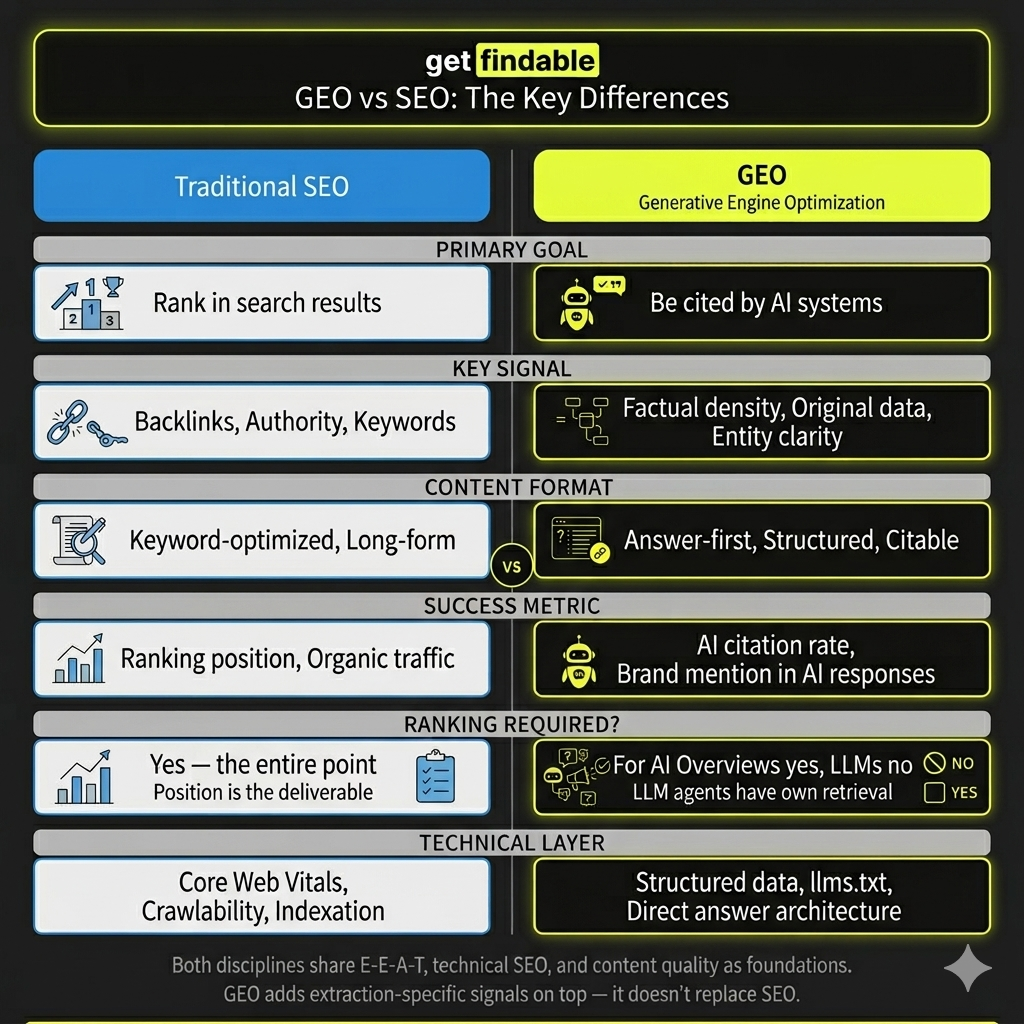
The core distinction: Traditional SEO optimizes for ranking position. GEO optimizes for extraction probability — whether an AI system chooses your page as a source when generating a response.
What is Generative Engine Optimization (GEO)?
Generative Engine Optimization (GEO) is the practice of structuring and enriching content so that AI systems — including Google AI Overviews, ChatGPT, Claude, and Perplexity — are more likely to cite it as a source when answering relevant queries.
GEO is not a rebrand of SEO. It addresses a fundamentally different problem: while SEO determines whether your page appears in a results list, GEO determines whether your content is extracted and used to generate an AI answer.
A page can rank #1 in Google and never appear in an AI Overview. A page ranked #45 might be cited by ChatGPT repeatedly. The ranking game and the citation game have overlapping but different rules.
GEO vs SEO: the key differences
The 6 signals that drive AI citations
Research on GEO signals consistently points to the same core factors. Here are the six that matter most:
1. Factual density and original data
AI systems are built to synthesize accurate information. Content that contains specific numbers, named entities, cited sources, and original data points is disproportionately likely to be extracted. A page that says “many companies are adopting AI” is far less citable than one that says “67% of Fortune 500 companies cited AI Overviews as an emerging traffic risk in Q3 2024, according to [source].”
2. Direct answer architecture
Google AI Overviews and LLM agents specifically look for pages that answer questions directly. This means:
- Placing the direct answer in the first 100 words
- Using the exact question phrasing as a heading
- Structuring content so the answer doesn’t require context to make sense
- Using FAQ sections with explicit Q&A format
3. E-E-A-T signals that extend beyond the page
Experience, Expertise, Authoritativeness, and Trustworthiness — these are the same signals Google has been pushing for years. For GEO, they translate to: visible author credentials, outbound citations to primary sources, explicit author bio, and content that demonstrates first-hand knowledge rather than generic synthesis.
4. Semantic completeness
When an AI is asked about a topic, it looks for content that covers the topic comprehensively. A page that covers a concept from multiple angles — definitions, examples, comparisons, limitations, applications — is more likely to be used as a source than one that covers only one dimension.
5. Citation-worthiness signals
Counterintuitively, content that itself cites other sources is more likely to be cited by AI systems. Linking out to primary research, government data, peer-reviewed studies, and authoritative sources signals that your content is part of the knowledge graph — not a dead end.
6. Crawler access control
Using llms.txt to explicitly tell AI crawlers which content to index — and which to ignore — is a new but rapidly growing GEO signal. Pages that are explicitly exposed in an llms.txt file have a higher probability of being indexed and cited by AI systems like Claude and Perplexity.
The two AI surfaces you need to optimize for separately
GEO isn’t a single target. The two most influential surfaces — Google AI Overviews and LLM agents like ChatGPT, Claude, and Perplexity — are fundamentally different and require separate optimization approaches.
- → Query alignment is critical
- → Direct answer in first paragraph
- → E-E-A-T signals heavily weighted
- → Structured data (FAQ schema) helps
- → Must already rank on page 1 or 2
- → Original data is the strongest signal
- → Entity density matters more than keywords
- → Outbound citations increase credibility
- → llms.txt controls crawler access
- → Ranking position less important
What GEO doesn’t replace
The good news for SEO professionals is that most of what you already know remains relevant — it just needs to be extended, not replaced.
- Technical SEO still matters. If AI crawlers can’t access your content, nothing else works. Indexability, canonical tags, and response times are all technical foundations for GEO.
- E-E-A-T is more important than ever. The expertise, authenticity, and trustworthiness signals Google has been pushing for years are the same signals that determine AI citation probability.
- Content quality compounds. SEO has always rewarded content that genuinely serves users. GEO rewards the same thing, with higher precision. Thin content that ranked through technical manipulation is increasingly worthless in an AI-mediated search environment.
- Backlinks matter, differently. Backlinks don’t directly influence AI citations — but they’re a strong proxy for domain-level authority that makes AI systems more likely to include your content in their retrieval set.
How to audit your content for GEO readiness
A basic GEO audit covers seven dimensions. For each piece of content you want to optimize:
| Dimension | What to check | Target |
|---|---|---|
| Direct answer | Is the query answered in the first 100 words? | Yes |
| Factual density | Stats, numbers, named sources per 500 words | 3+ |
| Author signals | Visible author bio with credentials? | Yes |
| FAQ section | Q&A format with common follow-up questions? | Yes |
| Outbound citations | Links to primary sources (not just other blogs)? | 2+ |
| Semantic coverage | Does the page cover the topic from multiple angles? | Yes |
| Crawler access | Is this page exposed in llms.txt? | Yes |
Want to score your content against these exact criteria? GEOscore audits any page against the six signals most predictive of AI citation — two scores, per-criterion breakdown, prioritized fixes. Takes 30 seconds.
Frequently asked questions about GEO
Is GEO the same as AEO (Answer Engine Optimization)?
AEO is an older term that referred specifically to optimizing for voice search and featured snippets. GEO is broader — it covers all AI-generated responses including chatbots, AI Overviews, and agentic search. The terms overlap but GEO is the more current and comprehensive framework.
Do I need to rank on Google to appear in AI Overviews?
For Google AI Overviews specifically, yes — Google’s index is still the primary retrieval layer, so pages that don’t rank at all are unlikely to be cited. For LLM agents like ChatGPT and Perplexity, ranking position is less important than content quality and crawler access.
How do I measure GEO performance?
The primary metrics are: AI citation rate (how often your brand or content appears in AI responses for target queries), branded AI visibility (whether AI systems describe your brand accurately), and zero-click impact (changes in organic traffic patterns as AI answers absorb more queries). Tools like GEOscore help audit content before publication; tracking brand mentions across AI systems helps measure performance over time.
Will SEO become irrelevant because of AI search?
No. AI search systems are built on web content — they need sources to cite. SEO ensures your content is findable, credible, and structured well enough to be used as a source. The discipline evolves, it doesn’t disappear. The professionals who will struggle are those who optimize purely for ranking position and never adapt to the extraction layer on top of it.
What is “GEO in marketing” vs “GEO in SEO”?
In marketing contexts, “GEO” often still refers to geographic targeting — serving different content or ads based on a user’s location. In SEO contexts since 2023, GEO has increasingly referred to Generative Engine Optimization. When searching for resources, always check which meaning is intended — the SEO meaning is the one growing fastest in professional use.