Google AI Overviews appear for a significant and growing share of search queries. When they do, they push organic results down the page and capture user attention before any blue link gets a click. Being the source that an AI Overview cites is now a meaningful traffic and brand visibility lever — and it’s optimizable.
Most guides on this topic tell you to write FAQ sections and use structured data. That’s step one. This guide covers the full signal set — including the non-obvious factors that most SEO teams are missing.
Key insight: Google AI Overviews don’t just extract from the #1 result. They synthesize from multiple sources — and they prioritize pages that answer the query directly, contain verifiable facts, and demonstrate author expertise. A page ranked #8 with the right signals can appear in an AI Overview over the #1 result without those signals.
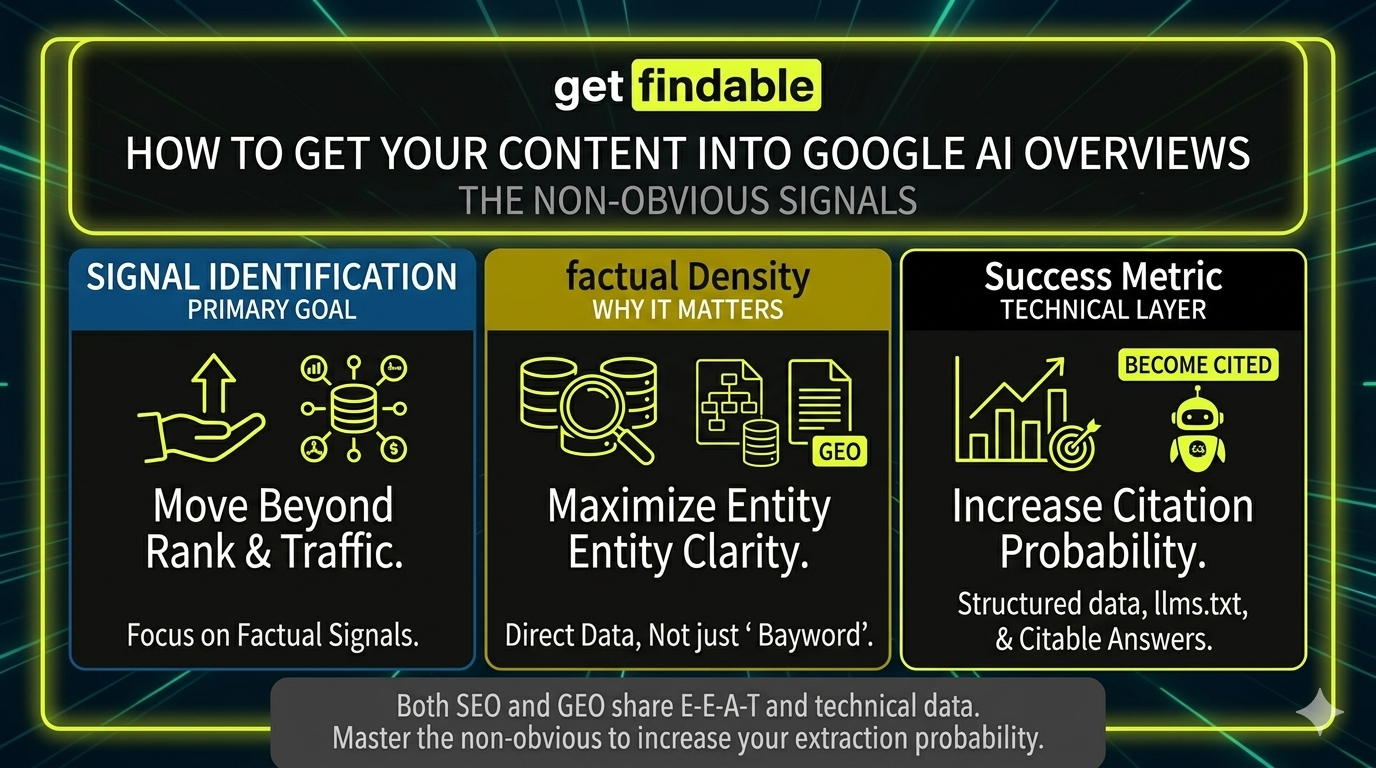
How Google AI Overviews select sources
Google hasn’t published a complete technical specification for AI Overview source selection. But from analysis of thousands of AI Overview citations, a consistent pattern emerges across five dimensions:
| Signal | What it means | Weight |
|---|---|---|
| Query alignment | Does the page directly answer the exact query asked? | Very high |
| Direct answer placement | Is the answer in the first paragraph — before context? | High |
| E-E-A-T signals | Visible author expertise, credentials, and authority | High |
| Content structure | FAQ format, clear headings, extractable passages | Medium-high |
| Ranking position | Must rank on page 1-2; position 1 is not required | Threshold (not linear) |
Signal 1: Query alignment (the most underestimated factor)
The most common mistake is optimizing for a keyword instead of a query. These are different things. A keyword is “AI Overviews optimization.” A query is “How do I get my content to appear in Google AI Overviews?”
AI Overviews are triggered by informational queries — questions, how-tos, definitions, comparisons. The pages that get cited are those that treat the query as the literal question it is and answer it directly.
Practical implementation:
- Research the exact phrasing of queries you want to appear in — not just the topic
- Use that exact phrasing as an H2 heading on your page
- Write the first paragraph under that heading as a direct, complete answer to the question
- Don’t assume the AI can infer the answer — state it explicitly
Signal 2: Direct answer architecture
Traditional SEO content often builds to the answer — context first, then conclusion. AI Overviews extraction inverts this. The system looks for the answer and then considers whether the surrounding content is authoritative enough to cite.
A page structured as “Here’s what you need to know → background → more background → the actual answer” will be outcompeted by a page structured as “The answer is X. Here’s why and how.”
Introduction paragraph about the topic → Historical context → Why this matters → Related concepts → Eventually: the actual answer
Direct answer in first paragraph → Supporting evidence → How-to steps → Context and nuance → FAQ with follow-up questions
Signal 3: E-E-A-T signals that AI Overviews evaluate
Google’s E-E-A-T framework (Experience, Expertise, Authoritativeness, Trustworthiness) is evaluated at the page level, author level, and domain level. For AI Overviews, the most actionable signals are:
Author expertise signals
- Visible author byline with name (not just “Staff” or “Editorial Team”)
- Author bio with relevant credentials, experience, and verifiable background
- Author page that links to published work, LinkedIn, or other verification sources
- First-hand experience signals — language like “In our testing,” “Based on my experience,” “When I analyzed” — that indicate direct knowledge
Page-level trust signals
- Outbound citations to primary sources (studies, official documentation, government data)
- Publication date that is recent or has a clear “last updated” timestamp
- Specific, verifiable claims rather than vague generalizations
Signal 4: Content structure for extraction
AI Overviews extract passages — they don’t summarize the whole page. This means your content needs to contain extractable units: self-contained paragraphs or answers that make sense independently of their context.
The formats most frequently cited in AI Overviews:
| Format | Why it works | Best for |
|---|---|---|
| FAQ sections | Pre-formatted Q&A pairs map directly to query-answer extraction | Definition and how-to queries |
| Numbered lists | Clear step-by-step format is easily extractable and displayable | Process and how-to queries |
| Definition paragraphs | Clear “X is Y” structure gives AI an extractable definition | “What is” queries |
| Comparison tables | Structured data that AI can reference for comparative queries | “X vs Y” queries |
| Callout boxes | Visually distinguished content signals importance to extraction systems | Key takeaways and warnings |
Signal 5: The ranking threshold
You must rank to be cited in AI Overviews — but ranking #1 is not required. Google’s AI Overview system draws from a wider candidate pool than the top 3 results. Pages ranking positions 4–15 are frequently cited when their content is more directly responsive to the query than higher-ranking pages.
This creates a specific opportunity: pages that rank on page 1 but not in positions 1–3 can sometimes outperform top results in AI Overview citations by having better-structured, more directly answering content.
A 7-point optimization checklist for AI Overviews
For each page you want to optimize for AI Overview citations, run through this checklist:
| Check | Criteria | Priority |
|---|---|---|
| Query match | Exact query phrasing appears as an H2 heading | Critical |
| Direct answer | Complete answer in first paragraph under the H2 | Critical |
| Author bio | Visible author with credentials and photo | High |
| FAQ section | At least 4 questions with explicit Q&A format | High |
| Outbound citations | At least 2 links to primary sources | Medium |
| Factual density | At least 3 specific statistics or data points per 500 words | Medium |
| Schema markup | FAQ schema or Article schema implemented | Medium |
Want to know exactly where your page stands against these criteria? GEOscore audits any page against the signals most predictive of Google AI Overview citations — per-criterion breakdown, prioritized fixes, 30 seconds.
Frequently asked questions about Google AI Overviews
Can I request to be included in AI Overviews?
No — there’s no manual submission process for AI Overviews. The system selects sources algorithmically based on the signals described in this guide. The only path to AI Overview citations is optimizing your content for the signals that drive selection.
Can I opt out of AI Overviews?
Yes — using the nosnippet or max-snippet: 0 meta tag will prevent your content from being used in AI Overviews. You can also block Google-Extended in your robots.txt to prevent your content from being used for AI training, though this may affect other Google AI features.
Do AI Overviews reduce organic traffic?
The evidence is mixed. For queries where AI Overviews appear, zero-click rates increase — users get their answer without clicking. However, being cited in an AI Overview can also drive brand awareness and qualified clicks from users who want more depth. The net impact depends heavily on query type, industry, and whether your site is cited or not.
How often does Google update which sources appear in AI Overviews?
AI Overview source selection is dynamic — it can change with each query, and Google updates the underlying models regularly. A page that appears in AI Overviews today may not tomorrow, and new optimizations may take days to weeks to be reflected. Treat AI Overview citation as a dynamic signal to optimize toward, not a fixed position to hold.
Does having structured data (schema) guarantee AI Overview inclusion?
No — structured data helps Google understand your content type and context, but it’s a supporting signal, not a guarantee. FAQ schema and Article schema are the most directly relevant for AI Overview optimization. Implement them, but treat them as one element of a broader optimization strategy rather than a shortcut.