Quick answer
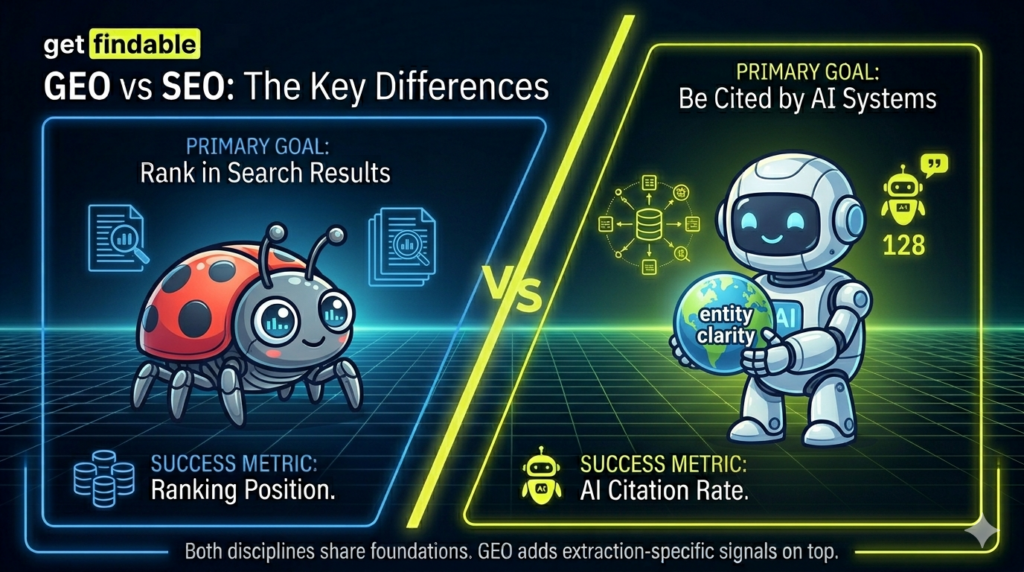
SEO (Search Engine Optimization) focuses on ranking in traditional search results to earn clicks. GEO (Generative Engine Optimization) focuses on being cited in AI-generated answers — in Google AI Overviews, ChatGPT, Perplexity, and similar AI search systems. SEO drives traffic. GEO drives citations and brand presence inside AI responses. Both matter. Neither replaces the other.
What is the difference between SEO and GEO?
Search Engine Optimization has been the dominant digital visibility discipline for two decades: optimize your pages for the right keywords, earn authority through backlinks, and rank high enough to get clicks.
Generative Engine Optimization is a newer practice built around a different question: when a generative AI system produces an answer to a query, does it cite your content as a source?
The two disciplines share some foundations — quality content, authority, trust — but they optimize for fundamentally different outputs. A page that ranks well in traditional search may still be completely invisible in AI search results, and vice versa. Adapting your content strategy to cover both is no longer optional for brands that depend on organic visibility.
GEO vs SEO: Key differences
| Dimension | SEO | GEO |
|---|---|---|
| Goal | Rank in search results | Be cited in AI-generated answers |
| Output | Links (SERPs) | AI-generated responses |
| Primary metric | Traffic, CTR, rankings | Mentions, citations, share of voice |
| Optimization focus | Keywords, backlinks, technical | Clarity, authority, semantic coverage |
| User behavior | Sees link → clicks | Reads AI answer → may or may not click |
| Control level | High (you control your page) | Low (AI decides what to cite) |
| Brand visibility | Requires a click to see | Can appear without any click |
| Timeline | Months to see impact | Weeks — but hard to measure directly |
Key takeaway
SEO gets you traffic. GEO gets you mentioned — sometimes to audiences who never visit your site at all.
Why GEO is fundamentally different from SEO
Search engines vs. answer engines
Traditional search engines return a ranked list of links. AI search systems — Google AI Overviews, ChatGPT, Perplexity, Claude — generate a direct answer, often without requiring the user to click anywhere. The user’s goal is fulfilled on the results page itself. This is the core behavioral shift driving the urgency around GEO.
Retrieval vs. generation
SEO is about getting your page retrieved — surfaced as a relevant result. GEO is about being selected as a source during answer generation. Generative AI doesn’t rank pages; it synthesizes content fragments into a response, then adds citations. Your content has to be structurally clear enough to be extracted accurately — answer-first, unambiguous, factually dense.
Ranking vs. selection
In SEO, Google’s algorithm ranks pages 1 through 10. In GEO, the AI selects 2 to 5 sources to cite in a response. The selection criteria are different: E-E-A-T signals, factual density, entity clarity, and citation-worthiness matter more than raw backlink count or exact keyword matching.
How AI search is changing user behavior
The data is now unambiguous. Every major study conducted since AI Overviews launched points in the same direction: AI-generated answers are absorbing clicks that used to go to organic results — and the shift is accelerating.
Ahrefs analyzed 300,000 keywords and found that the presence of an AI Overview now correlates with a 58% lower click-through rate for the top-ranking page — down from 34.5% when they first ran the study in April 2025. The decline is accelerating as AI search expands to more query types and markets.
Seer Interactive’s analysis of 25.1 million impressions across 42 organizations puts the organic CTR drop at 61% for informational queries where AI Overviews appear. Multiple independent studies confirm the same trend, with declines ranging from 15% to 89% depending on query type — but the direction is unanimous.
Being cited changes everything
Here’s what makes GEO worth investing in: being cited inside an AI search response is measurably better than not being cited, even on the same query.
Key data point — Seer Interactive, September 2025
Brands cited within an AI Overview earn +35% more organic clicks and +91% more paid clicks compared to brands on the same query that aren’t cited. Citation in AI search is the new position zero.
Early UX research also suggests that users primarily engage with the top portion of AI-generated answers, reinforcing why being cited early in the response — not just anywhere — matters for actual visibility.
SEO vs. GEO in real scenarios
Query: “What is life insurance?”
SEO
Google returns a list of links. Insurers and publishers compete for top spots. Users scroll and choose.
GEO
Generative AI produces a direct definition and cites 3–4 sources. If you’re not among them, your brand is absent — even if you rank #1.
Query: “Best credit card in Canada”
SEO
Comparison pages compete for clicks. Rankings and rich snippets determine who gets seen.
GEO
AI generates a shortlist based on perceived authority and factual density. The model decides which brands are included — and which aren’t mentioned at all.
How to adapt your content strategy for SEO and GEO
SEO content strategy
- →Keywords and search intent alignment
- →Backlinks and domain authority
- →Technical performance
- →On-page structure and internal linking
- →Engagement signals
GEO content strategy
- →Clear, direct answers to target questions
- →Topical authority and E-E-A-T signals
- →Citation-worthiness: original data, named sources
- →Semantic richness and entity density
- →Structure generative AI can extract cleanly
In practice, the two approaches reinforce each other. Content written for GEO — direct, structured, authoritative — tends to perform better in traditional SEO as well. The inverse isn’t always true: keyword-optimized content with thin context often scores poorly in AI search.
Key takeaway
GEO optimization is less about ranking signals and more about trust and citation signals. You’re writing for a generative AI system that has to decide whether your content is worth referencing in front of a user.
Why brands need both SEO and GEO
SEO and GEO are not competing strategies — they are complementary. The mistake is treating them as alternatives within your content strategy.
Traditional SEO remains critical for transactional queries, product discovery, and bottom-of-funnel traffic acquisition. An AI Overview rarely appears for “buy running shoes size 11” — the user has clear purchase intent, and Google surfaces product listings, not generative AI summaries.
GEO becomes essential for informational queries, brand authority building, and visibility inside AI search ecosystems where users are forming opinions before they ever search with buying intent.
Key takeaway
SEO drives acquisition. GEO drives influence. A brand that ranks well but is never cited in AI search responses is invisible at the moment users are forming purchasing intent — often before they even know what they’ll search next.
Is GEO replacing SEO?
No — but it is redefining what visibility means.
Research shows that 97% of AI Overview citations come from pages that already rank in the top 20 organic results. That means traditional SEO is still the foundation — you can’t earn GEO citations if you’re not already a credible, indexed source. Strong SEO is a prerequisite for AI search visibility, not an alternative to it.
What’s changing is the ceiling. Ranking #1 used to mean capturing most of the clicks on a query. In 2026, it increasingly means you’re a candidate to be cited by generative AI — but citation isn’t guaranteed, and the model decides, not the algorithm.
How to measure GEO performance
Unlike SEO, GEO performance can’t be read directly from Google Search Console or Analytics. Dedicated AI tools are emerging to track this, but the core indicators remain: brand mentions in AI responses, citation frequency in Google AI Overviews for priority queries, share of voice across AI search platforms, and branded search lift as a downstream signal of generative AI-driven awareness.
Definition: What is GEO (Generative Engine Optimization)?
Definition
Generative Engine Optimization (GEO) is the practice of optimizing content to increase the likelihood of being cited, referenced, or used as a source in AI-generated answers — including Google AI Overviews, ChatGPT, Claude, Perplexity, and other generative AI systems. Unlike SEO, which optimizes for ranking position in traditional search results, GEO optimizes for selection as a trusted source during AI answer generation. It requires a distinct content strategy focused on clarity, factual density, and topical authority.
Not sure how your content scores in AI search?
GEOscore audits your content for both Google AI Overviews and LLM agents — two scores, a per-criterion breakdown, and prioritized quick wins in under 30 seconds.
Works on drafts and published content. Paste your text — no URL needed. Uses your own Anthropic API key.
Audit your content with GEOscore →FAQ
What is AI search, exactly?
AI search refers to search interfaces that use generative AI to produce a direct answer to a query, rather than returning a list of links. Google AI Overviews, Perplexity, ChatGPT Search, and Claude are all examples of AI search systems. They generate a synthesized response from multiple sources and — sometimes — cite those sources inline. The defining characteristic is generation, not retrieval.
How does generative AI decide which content to cite?
No model publishes its exact selection criteria, but research and experimentation point to consistent signals: pages that already rank well in traditional search, content with clear direct answers to the query, strong E-E-A-T signals (authorship, citations, original data), entity clarity, and factual density. Generative AI tends to favor content that can be extracted and paraphrased cleanly — not content that requires extensive context to understand.
Should I update my content strategy for GEO?
Yes — if informational queries matter to your business. A content strategy built purely for keyword rankings will underperform in AI search, where the signals are different. In practice, adapting your content strategy for GEO doesn’t mean abandoning SEO fundamentals: it means adding a layer of answer-first structuring, topical authority building, and citation-worthiness signals on top of what you already do.
Are there AI tools specifically designed for GEO optimization?
The tooling landscape is still young. Most existing SEO tools weren’t built with generative AI citation signals in mind. Dedicated AI tools for GEO — like GEOscore — audit content specifically against the criteria that drive AI Overview and LLM citation: directness, factual density, E-E-A-T signals, and semantic structure. Traditional SEO tools like Semrush or Ahrefs remain essential for the SEO layer, but they don’t address GEO-specific signals.
Does GEO work for all types of content?
GEO has the most impact on informational content — definitions, comparisons, how-tos, category explainers. These are the query types most likely to trigger an AI Overview or a generative AI response. For transactional content (product pages, pricing, landing pages), traditional SEO remains the dominant lever. A balanced content strategy accounts for both: GEO-optimized informational content to build presence in AI search, and SEO-optimized transactional content to capture purchase intent.
How long does it take to see results from GEO optimization?
Faster than traditional SEO in some cases — an updated or newly published page can be indexed and cited in AI search within days or weeks. But measuring it consistently is the harder problem: citation frequency in AI search doesn’t appear in Search Console. The clearest downstream signals are branded search lift and direct traffic increases, which take longer to accumulate. Treat GEO as a medium-term authority-building effort, not a quick-win channel.