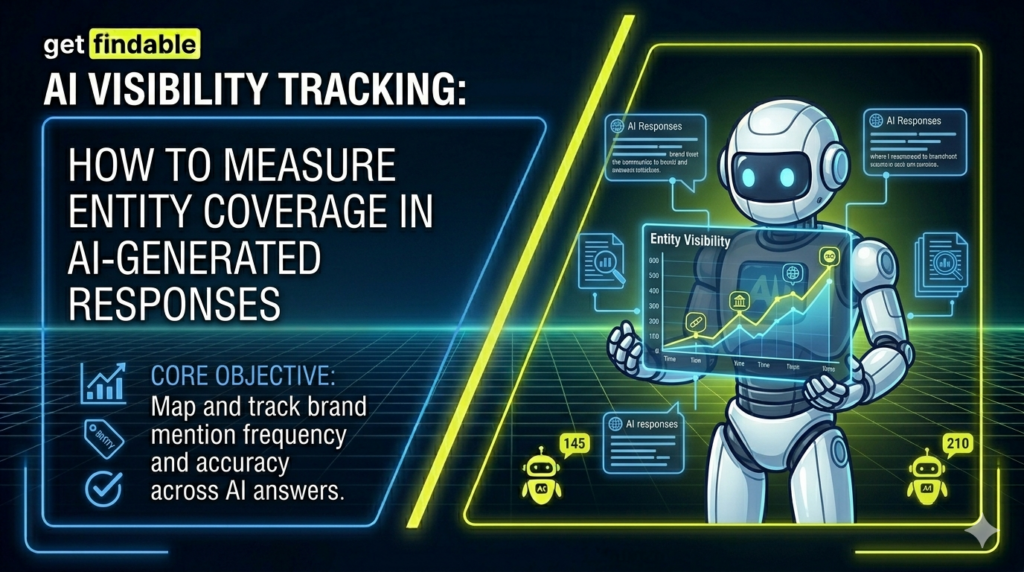
A brand manager opens ChatGPT and asks a straightforward category‑level question: "What are the leading platforms for enterprise data security?" The response is confident, well‑structured, and completely omits their company. There's no ranking drop to investigate, no lost impressions in Search Console—just absence. This is not a backlink problem or a keyword gap. It's an AI visibility problem.
AI Visibility is the measurable degree to which a brand, topic, or entity is accurately and prominently represented in AI‑generated responses across generative platforms such as ChatGPT, Gemini, Microsoft Copilot, and Perplexity. Improving this visibility is the focus of Generative Engine Optimization (GEO), the discipline of optimizing content so it can be accurately retrieved, interpreted, and cited by generative AI systems.
This article explains the two primary mechanisms that determine AI visibility—Entity Coverage and Citation Signal—and introduces a practical audit framework grounded in how generative systems retrieve, disambiguate, and assemble answers.
What Is AI Visibility and Why Does It Matter for Your Brand?
When a user asks a generative AI system to recommend tools, explain a concept, or summarize a category, the model does not return a list of links. It produces a synthesized answer that weaves together entities it considers relevant, credible, and complete. Whether your brand appears in that answer is a measurable outcome—and one that increasingly shapes discovery and trust.
AI Visibility is the measurable degree to which a brand or entity is accurately and prominently represented in AI‑generated responses across platforms like ChatGPT, Gemini, Microsoft Copilot, and Perplexity. This outcome is distinct from traditional SEO rank. Ranking determines whether a page appears in a list of results; AI visibility determines whether your brand is embedded directly into the generated narrative itself.
AI visibility can be measured across three dimensions:
Together, these dimensions provide a repeatable framework for tracking AI visibility over time.
How Do AI Models Decide Which Entities to Reference in a Response?
Generative AI systems do not crawl the web in real time when answering a question. They rely on training data and, in Retrieval‑Augmented Generation (RAG) systems, indexed content that can be retrieved at query time. Retrieval‑Augmented Generation is an architecture in which an AI model generates responses by combining its internal knowledge with externally retrieved content chunks, rather than relying solely on parametric memory.
In RAG pipelines, each retrieved chunk must independently provide clear entity definitions and context, because the model evaluates and assembles answers based on what can be confidently extracted from those chunks. Entity Coverage determines whether AI retrieval systems can fully satisfy the semantic scope of a topic from a given content chunk. A page must explicitly name, define, and develop the concepts an AI associates with that topic.
Entity disambiguation is the process by which AI systems resolve which specific brand or concept a term refers to when multiple similar entities exist. Structured Data and Knowledge Graph presence play a critical role in this process. For example, Organization schema markup that defines a company's legal name, logo, founding date, and official URL helps AI systems distinguish that brand from similarly named entities. When this structured information aligns with a verified Knowledge Graph entry—such as a Google Knowledge Panel or a Wikidata record—the model can confidently associate mentions across sources with the same entity, improving accuracy and prominence in AI‑generated responses.
Knowledge Graph — A structured representation of entities and their relationships, built from authoritative sources such as Wikidata, Wikipedia, and trusted publisher sites. Brands can establish or verify their Knowledge Graph presence by maintaining consistent entity information across these sources and validating public profiles that feed into knowledge panels. For generative systems, this alignment acts as an identity anchor that directly supports AI visibility.
What Is Integration State and How Does It Signal Content Quality to AI?
Entity coverage alone is not sufficient. How an entity is developed within a content chunk determines whether an AI model can confidently reference it. Integration State classifies how thoroughly an entity is developed, explained, and semantically connected within a content chunk, using four labels:
Named, clearly defined, and connected to adjacent concepts within the same chunk.
Mentioned but not explained or linked to related ideas.
Appears only as a label, offering no definitional or contextual support.
Referred to using different terms or abbreviations across the same chunk, creating ambiguity for retrieval.
Integration state functions as a quality threshold between entity coverage and citation signal. When an AI model extracts a chunk to answer a query, it needs entities to be well integrated to cite them confidently. Anything below that threshold reduces citation probability and weakens AI visibility.
What Is a Citation Signal and Which Content Characteristics Drive It?
A Citation Signal increases the probability that an AI language model selects and cites a source in a generated answer by combining factual explicitness, editorial neutrality, and demonstrated authority. These characteristics help a model assess whether a piece of content can be trusted as a reference.
Favors specific data, named entities, and defined terms over vague claims.
Reflects an informational tone rather than promotional language.
Includes author credentials, sourced claims, and institutional context.
"This platform offers leading data governance capabilities"
Low citation value — vague, promotional.
A sentence that references a named study with verifiable findings provides significantly more citation value.
Strong citation signals are not about influencing models artificially; they are the natural result of clear, authoritative, and well‑supported writing.
How to Audit Your Content for AI Visibility: A Step‑by‑Step Process
Low entity coverage produces weak or absent AI visibility because AI retrieval systems cannot extract a confident, complete answer from content that does not fully develop the expected semantic scope of a topic.
How Do Entity Coverage and Citation Signal Work Together to Build AI Visibility?
Entity coverage and citation signal together determine AI visibility by controlling both semantic completeness and credibility. Entity coverage acts as a map, showing an AI model where your content lives within a topic space. Integration state reflects how clearly that map is drawn. Citation signal functions as the credential that tells the model whether it should trust what it finds.
Semantic SEO focuses on structuring content to satisfy search engine understanding, while GEO extends this discipline to generative systems by optimizing entity coverage, integration state, and citation signals for AI‑generated responses. When these elements are aligned, brands are more consistently included in generated answers across platforms.
Frequently Asked Questions
How often should I audit my content for AI visibility?
At minimum, quarterly, or after major content updates or when a new generative platform gains significant user adoption.
Does AI visibility correlate with traditional SEO rankings?
Partially. Domain authority and structured content support both, but AI visibility depends more heavily on entity coverage and integration state than on backlink profiles.
Can a single page have high citation signals but low entity coverage?
Yes. A page can be authoritative and factual while still missing key entities AI models expect for a topic, resulting in limited or no citation.
What is the fastest fix for low integration state?
Add an explicit definition sentence for each underexplained entity within the same content chunk where it is first mentioned.